 MEMBERSHIP LOGIN
 JOIN PRI
IMRRC Talk Subject: Ray Crawford
Image
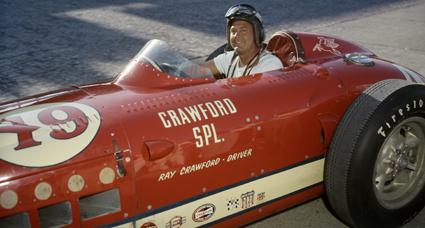
Ray Crawford, a 1950s-era Indianapolis 500 racer, who also was a combat fighter ace and test pilot and a millionaire business mogul, will be the subject of the May 14 Center Conversations talk at the International Motor Racing Research Center.
“Ray Crawford’s life has to be one of the most inspirational stories to come out of the Greatest Generation,” said Andrew Layton, author of “Ray Crawford - Speed Merchant: A California Grocer’s Love Affair with Risk, From P-38 Lightnings to the Indianapolis 500.” The book was published last year.
Layton will speak at 1 p.m. on Saturday, May 14. Originally scheduled for earlier in the month, the free event is open to all. The Racing Research Center is located at 610 S. Decatur St., Watkins Glen, N.Y.
The May talk comes as the Indianapolis 500 is celebrating its 100th anniversary. A 1957 Indy roadster and a 1950s-era midget car are currently on display at the Racing Research Center.
Competing from 1947 to 1963 in what was arguably racing’s wildest era, Crawford entered more than 200 races in Indy cars, midgets, stock cars, sports cars, championship dirt cars and even unlimited hydroplanes, Layton said. Crawford’s crowning achievement was a victory in the 1954 Carrera Panamericana road race, a border-to-border dash across Mexico, which some consider to be the most dangerous contest in motor racing history, according to Layton.
Layton is planning to include in his presentation Crawford's Mexican in-car films, which were very influential as some of the first-ever color in-car camera shots to come out of professional motorsports.
Layton said his interest in Crawford is natural, especially considering the racer’s background as a P-38 Lightning fighter pilot in World War II. Crawford shot down at least six Axis aircraft over North Africa in 1943 and returned to become the third military pilot to certify on the P-80 Shooting Star – America’s first operational jet fighter. He flew with America’s ace of aces, Major Richard Bong, on the day Bong was killed in a freak crash. Viewed as a scapegoat for the major’s death, Crawford was ousted from the flight test program and spent the next several years adrift before his rebirth as a race-car driver.
Layton is no stranger to Crawford’s brand of military aviation and racing acumen. His 2005 book “Wolverines in the Sky” tells the stories of 56 fighter aces who hailed from Michigan. Layton also wrote “Eagles’ Wings” (2007), the story of World War II prisoners of war Jack Curtis and Larry Jenkins, and in 2012, “Downrange,” a novel based on some of his own experiences as an Air Force veteran of the wars in Iraq and Afghanistan.
Layton’s grandfather, a lifelong racing enthusiast, built circle-track entries in the 1950s and ’60s and later restored many of the top cars driven by Crawford’s competitors.
“People ask, why Ray Crawford? Well, the answer’s pretty easy: He’s right at the intersection of two fields that I’m absolutely passionate about,” said Layton, whose research for the book about Crawford inspired him to begin racing cars himself. He now competes in Sports Car Club of America events throughout Michigan and Ohio.
Layton was assisted in research for the Crawford book by IMRRC staff and materials from the IMRRC’s collections.
In 2010, Layton’s writing was recognized with the Michigan Aviation Hall of Fame’s Harriet Quimby Award for literary excellence. Layton holds degrees in English and Political Science and resides in Michigan with his wife, Elise.
The International Motor Racing Research Center is an archival and research library dedicated to the preservation and sharing of the materials of motorsports history, of all series and all tracks, worldwide.
“Ray Crawford’s life has to be one of the most inspirational stories to come out of the Greatest Generation,” said Andrew Layton, author of “Ray Crawford - Speed Merchant: A California Grocer’s Love Affair with Risk, From P-38 Lightnings to the Indianapolis 500.” The book was published last year.
Layton will speak at 1 p.m. on Saturday, May 14. Originally scheduled for earlier in the month, the free event is open to all. The Racing Research Center is located at 610 S. Decatur St., Watkins Glen, N.Y.
The May talk comes as the Indianapolis 500 is celebrating its 100th anniversary. A 1957 Indy roadster and a 1950s-era midget car are currently on display at the Racing Research Center.
Competing from 1947 to 1963 in what was arguably racing’s wildest era, Crawford entered more than 200 races in Indy cars, midgets, stock cars, sports cars, championship dirt cars and even unlimited hydroplanes, Layton said. Crawford’s crowning achievement was a victory in the 1954 Carrera Panamericana road race, a border-to-border dash across Mexico, which some consider to be the most dangerous contest in motor racing history, according to Layton.
Layton is planning to include in his presentation Crawford's Mexican in-car films, which were very influential as some of the first-ever color in-car camera shots to come out of professional motorsports.
Layton said his interest in Crawford is natural, especially considering the racer’s background as a P-38 Lightning fighter pilot in World War II. Crawford shot down at least six Axis aircraft over North Africa in 1943 and returned to become the third military pilot to certify on the P-80 Shooting Star – America’s first operational jet fighter. He flew with America’s ace of aces, Major Richard Bong, on the day Bong was killed in a freak crash. Viewed as a scapegoat for the major’s death, Crawford was ousted from the flight test program and spent the next several years adrift before his rebirth as a race-car driver.
Layton is no stranger to Crawford’s brand of military aviation and racing acumen. His 2005 book “Wolverines in the Sky” tells the stories of 56 fighter aces who hailed from Michigan. Layton also wrote “Eagles’ Wings” (2007), the story of World War II prisoners of war Jack Curtis and Larry Jenkins, and in 2012, “Downrange,” a novel based on some of his own experiences as an Air Force veteran of the wars in Iraq and Afghanistan.
Layton’s grandfather, a lifelong racing enthusiast, built circle-track entries in the 1950s and ’60s and later restored many of the top cars driven by Crawford’s competitors.
“People ask, why Ray Crawford? Well, the answer’s pretty easy: He’s right at the intersection of two fields that I’m absolutely passionate about,” said Layton, whose research for the book about Crawford inspired him to begin racing cars himself. He now competes in Sports Car Club of America events throughout Michigan and Ohio.
Layton was assisted in research for the Crawford book by IMRRC staff and materials from the IMRRC’s collections.
In 2010, Layton’s writing was recognized with the Michigan Aviation Hall of Fame’s Harriet Quimby Award for literary excellence. Layton holds degrees in English and Political Science and resides in Michigan with his wife, Elise.
The International Motor Racing Research Center is an archival and research library dedicated to the preservation and sharing of the materials of motorsports history, of all series and all tracks, worldwide.